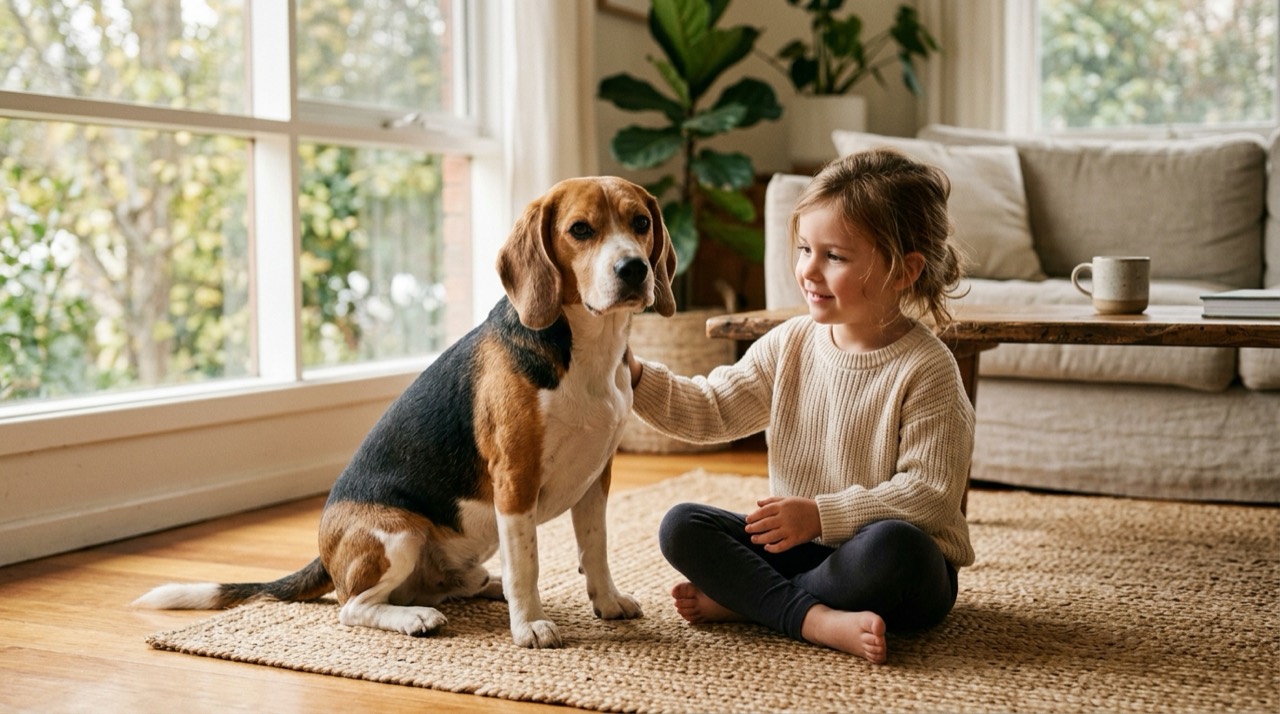
Short answer: yes, usually. The AKC describes the beagle as a merry, easygoing breed that is good with young children, and says it suits almost any family that can give it exercise and company. But "good with kids" is never automatic for any dog, and beagles have a few breed-specific quirks that families need to plan for.
Why beagles tend to suit families
- Sociable by design. Beagles were bred to hunt in packs, so they are used to company. The AKC says they enjoy the company of both people and other dogs, and the WSAVA calls the UK breed standard's "merry, amiable hound" the reason the breed is so popular as a companion.
- Sturdy build. Despite their size, the AKC calls them sturdy, which makes them less fragile around boisterous play than many small breeds.
- Low-fuss coat. The short coat needs weekly brushing and few baths, which keeps care simple.
How common is aggression?

In the 2025 VetCompass study of UK pet beagles (3,729 dogs with full records reviewed), aggression was recorded in 1.85% of beagles, more often in males (2.44%) than females (1.20%). A further 4.9% were recorded as anxious or distressed. This comes from vet visit records, so it captures problems owners reported, not every incident, but it suggests aggression is uncommon in the breed. See our summary of what the vet records show.
What families need to plan for
1. Food. The AKC warns that beagles take their food very seriously and that children must be taught never to tease a beagle while it is eating. Set a house rule: kids don't touch the bowl, bones or chews, and never reach toward a dog that is eating. Feed in a separate area, and see how to stop food stealing.
2. Time alone. Beagles can become destructive and noisy when left alone for long periods. A busy family with someone usually home is a better fit than one where the dog is alone all day. Read about separation anxiety before you commit.
3. Exercise. They need a good amount of physical and mental activity, and do best in an active household. Children can help with games, but a dog can't be exercised by a kid's backyard play alone.
4. Noise. The AKC calls the beagle one of the more vocal breeds. If someone in the house is a light sleeper or works nights, plan for howling.
5. Safety outdoors. Because of their scent-hound heritage, the AKC says beagles should not be off-lead unless in a securely fenced area. Teach children to keep gates and doors closed.
Supervision and teaching kids
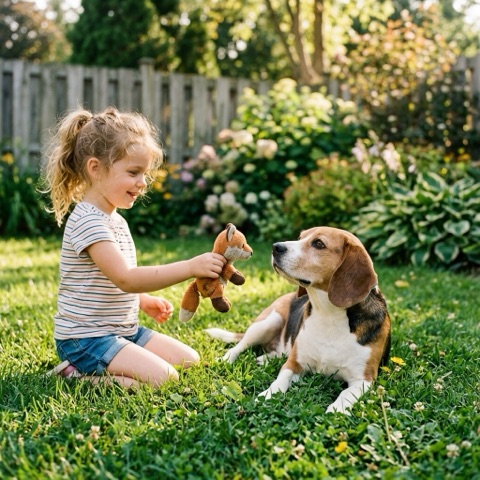
No breed profile replaces supervision. Good basics for any dog and child:
- Always supervise young children with the dog.
- Teach gentle touch: stroke the chest and shoulders, don't pull ears or tail, don't climb on or hug tightly.
- Let the dog retreat to a crate or bed that children never enter.
- Learn the signs of stress (yawning, lip licking, turning away, stiffening) and stop interacting when you see them.
- Train the dog too. Beagles respond well to treats and poorly to harsh methods (AKC), so involve older children in positive-reinforcement training.
Puppy or adult?
Puppies are cute but need constant management: potty training, biting and sleepless nights. An adult from a rescue or breeder, with a known temperament around children, can be easier for a family with toddlers. Ask what the dog has lived with before.
Frequently asked questions
Are beagles good with toddlers? They can be, with close supervision. The AKC lists them as good with young children, but toddlers can't read dog body language, so an adult should always be present.
Are beagles aggressive? Rarely. In UK vet records, 1.85% of beagles had a recorded aggression problem.
Do beagles bite? Any dog can. Puppies mouth a lot, which is normal and trainable (see puppy biting).
Do beagles do well with other pets? The AKC says beagles enjoy the company of other dogs. See beagles with dogs and cats.
General information, not behavioural advice for your specific dog or child.
Sources
- AKC, "Is the Beagle a Good Fit for You?": https://www.akc.org/expert-advice/dog-breeds/beagle-right-for-you/
- O'Neill DG, et al. "Beagles kept as companion animals in the UK." Companion Animal Health and Genetics, 2025: https://pmc.ncbi.nlm.nih.gov/articles/PMC11827713/
- WSAVA, "Meet the Beagle": https://wsava.org/updates/meet-the-beagle-update-your-knowledge/