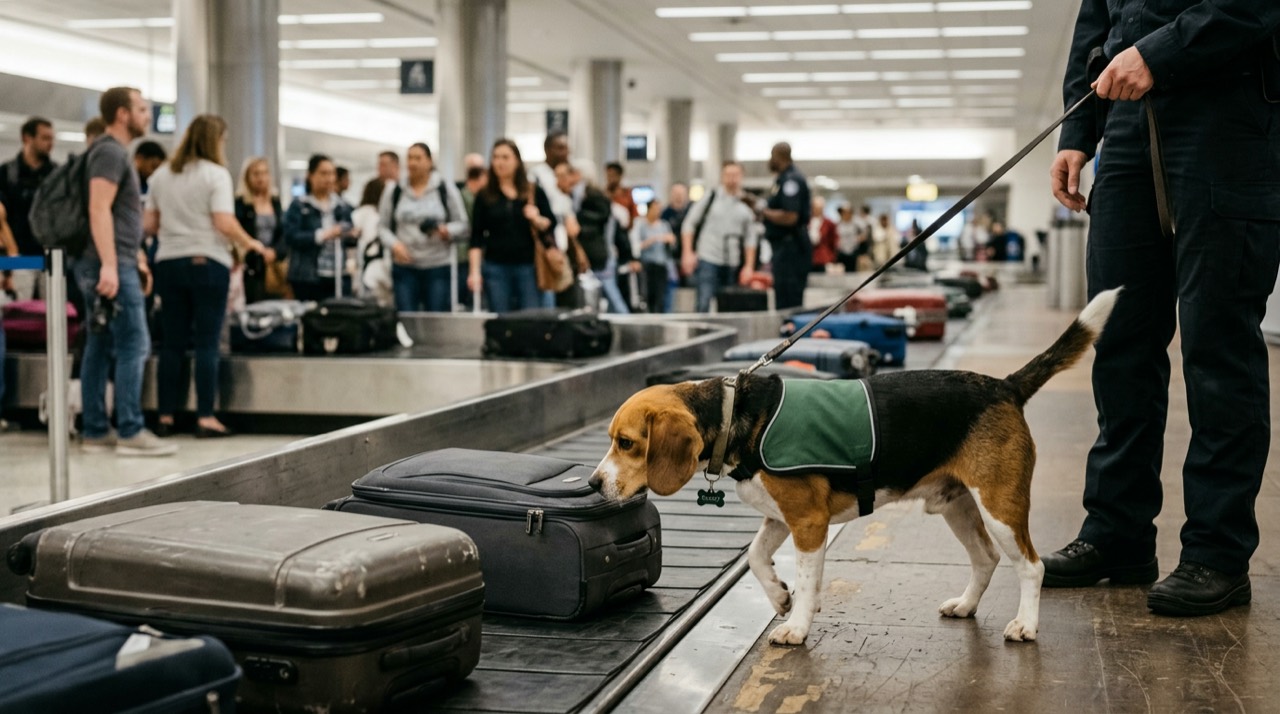
If you've flown into the United States from abroad, you may have seen a beagle in a green jacket working the baggage claim, nose down, tail up. These are the dogs of the USDA's Beagle Brigade, and they say a lot about what your beagle's nose is really for.
A short history
The program began in 1984 at Los Angeles International Airport, when the USDA's Animal and Plant Health Inspection Service (APHIS) set up its detector dog program with one team: a beagle and a handler. APHIS had tried various breeds before settling on beagles, and early teams trained with the military at Lackland Air Force Base in Texas. Around 1987, APHIS opened regional training centres, later consolidated into a national training centre in Orlando, Florida. A 1987 Christian Science Monitor report described beagles then stationed at five major airports: San Francisco, Los Angeles, New York, Miami, and Seattle.
When US Customs and Border Protection was formed in 2003, the Beagle Brigade moved into CBP. The USDA also later added larger dogs, such as Labrador retrievers, for border and cargo work, outside the passenger areas where a smaller dog fits better.
(Today's numbers vary by source, from about 20 airports to several dozen. For a current figure, check USDA APHIS or CBP directly.)
Why beagles?
Two reasons come up repeatedly:
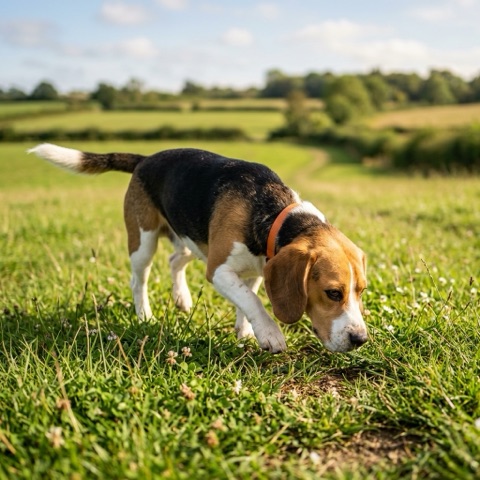
- Nose. Beagles were bred to track hare by scent, and their drive to follow a smell is stronger than almost any other trait.
- Temperament. They're friendly, small, and not intimidating, which matters when you're working among tired travellers. Many Brigade dogs were donated by owners and breeders or rescued from shelters.
The dogs are trained to find specific agricultural items, like fruit, meat, and plants, that could carry pests and diseases into American farms.
What this tells you about your beagle
Your pet isn't a detection dog, but it comes from the same drive. That has practical consequences.
Nose-first is normal. What owners call stubbornness is often a dog doing its job. One well-known training principle for scent hounds: when a smell is interesting, your voice loses to it. Plan for that rather than expect perfect off-leash behaviour.
Recall needs management. Experienced trainers recommend:
- Use a long line (10 to 30 feet) in open spaces until recall is rock solid, and accept that for many beagles it may never be 100% reliable off-leash.
- Pick a distinctive recall signal, such as a whistle, and pair it only with high-value rewards.
- Build up in steps: name response indoors, add distractions, practise on a long line outdoors, and only then raise the difficulty.
- Keep a secure fence for unsupervised time. Beagles that follow a trail across a road are at serious risk. The WSAVA notes that in Swedish insurance data, injury (especially vehicle strikes) was a leading cause of death for beagles, at over 2.5 times the all-breed rate.
More training demos in our Training videos.
Give the nose a job. Letting a beagle do scent work is the best fix for most boredom behaviour, including excess howling (why beagles howl).
Try it at home: three beginner nose games
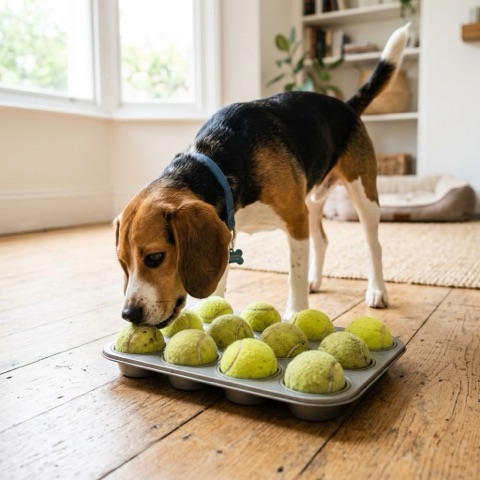
- Find it. Toss a treat on the floor and say "find it." Gradually drop them where the dog can't see.
- Muffin-tin game. Put treats under some cups of a muffin tin with tennis balls over all of them. The dog learns to search each one.
- Hide and seek with a toy or treat. Start in one room, make the hide easy, then make it harder.
Short sessions of 5 to 10 minutes are plenty. Many dogs find mental work tiring.
If you want to go further, there are organised dog scent-work sports with classes in most areas. Ask a local trainer.
Frequently asked questions
Do beagles really have the best nose? Beagles are among the most scent-driven breeds and are widely used for detection work. We wouldn't claim a "best" because the evidence isn't that precise.
Can I get my beagle certified as a detection dog? The Brigade trains its own dogs and handlers. Pet owners can compete in scent-work sports instead.
Why do beagles ignore commands outdoors? Their scent drive can override training. Use management and gradual proofing.
What does the Beagle Brigade look for? Prohibited agricultural items, such as fresh fruit, meat, and plants.
Sources
- CBP timeline, 1984: https://www.cbp.gov/about/history/timeline/timeline-date/1984
- The Christian Science Monitor, "The Beagle Brigade" (4 May 1987): https://csmonitor.com/1987/0504/hbeagle.html
- Wyoming Livestock Roundup / WYLR, "USDA's Beagle Brigade searches for prohibited ag products at major airports" (1 Nov 2024)
- WSAVA, "Meet the Beagle": https://wsava.org/updates/meet-the-beagle-update-your-knowledge/
- ZoomRoom, Beagle Recall Training (trainer guidance; not peer-reviewed)